
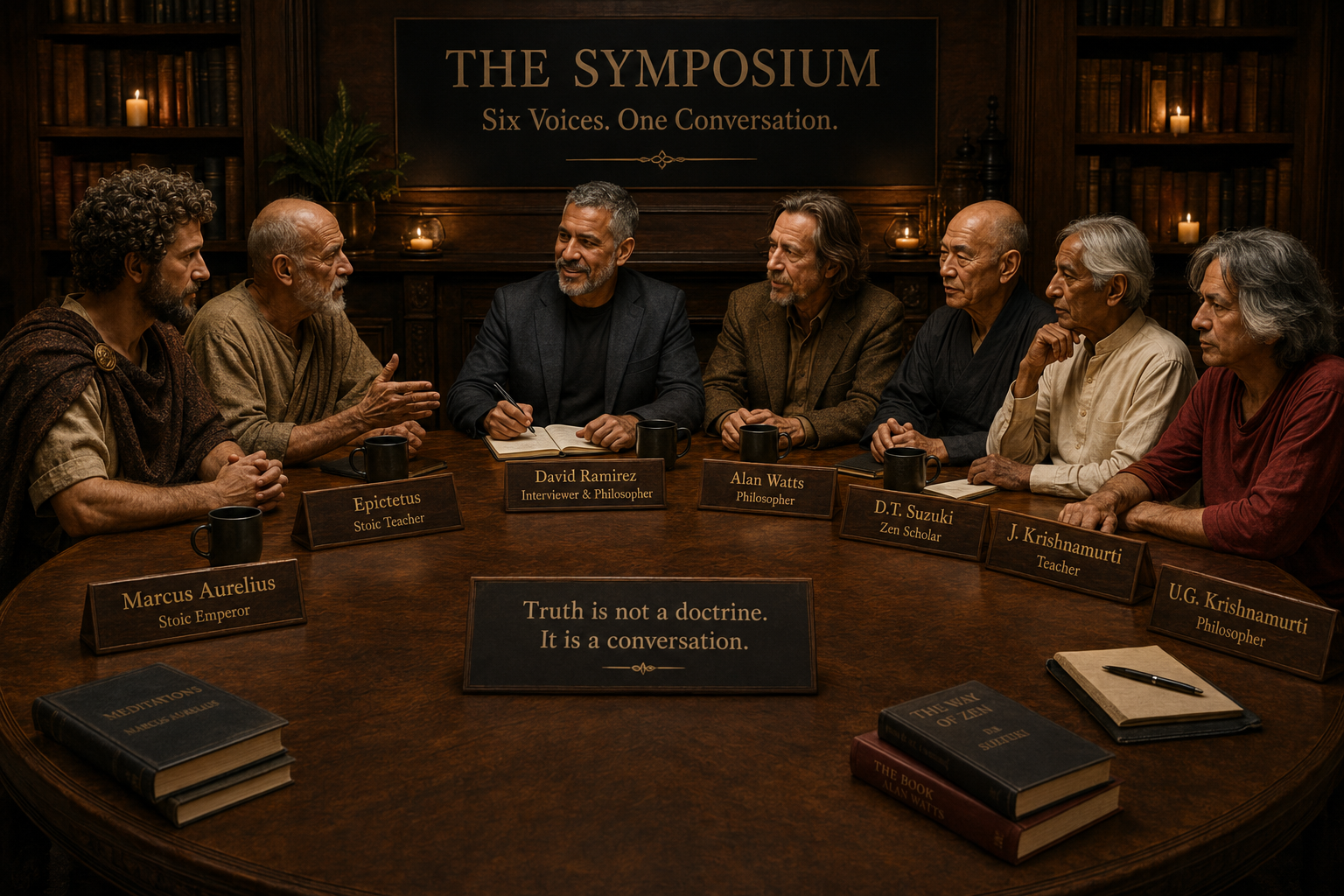
The Table
One long room, evening. Six chairs that should never have shared a century: Marcus Aurelius, the Stoic emperor; Epictetus, the freed slave who taught him a school; Alan Watts, the Englishman who made Zen sound like jazz; D.T. Suzuki, who carried Zen to the West in earnest; J. Krishnamurti, who dissolved his own following rather than be a teacher; and U.G. Krishnamurti, who dissolved the idea that there was anything to teach. I sit at the head, not to referee but to ask. What follows is imagined: a dramatization grounded in their published work, not a transcript. The lines against a green margin are genuine, cited at the end; the rest is mine.
I. On Fear
David. We begin where everyone secretly begins. What is fear, and what is it really about?
Epictetus. It is never about the thing. It is about the story you tell over the thing.
Men are disturbed not by the things which happen, but by their opinions about the things.Epictetus, Enchiridion (trans. Elizabeth Carter, 1758)
Marcus. And almost every fear, traced back, is the one fear: that I will end. Name it plainly and it loses its hold. The judging mind is yours; the event is not.
U.G. You are all still being polite about it. Fear is the self protecting itself, that is its only job. There is no problem to solve. The trouble is you will not let the fear simply be a movement in the body; you turn it into a someone who is afraid.
Watts. Yes, and the harder you grip against it, the more you drown. Fear is the sensation of bracing against a river that was going to carry you anyway.
II. On Belief
David. My own work says we become what we believe about ourselves. So I have to ask the table: are beliefs the cure or the disease?
J. Krishnamurti. Belief is the bandage over the wound of not-knowing. You believe because you cannot bear to look without a conclusion. Drop the conclusion and you might actually see.
U.G. All of it is secondhand. Every noble thought in your head was put there by someone else. You call it your philosophy; it is other people's noise repeating in you.
Marcus. And yet a man must act before dawn with no certainty at all. I did not believe in the gods so much as I refused to be ruled by the fear of their absence. Use the belief as a tool; do not let it use you.
David. That is close to my own line. Belief in motion is what slowly becomes a life, so the work is to hold it loosely, not to abolish it.
III. On the Ego
David. Then the thing under all of it. The self, the ego. Is it real?
Watts. It is a sensation mistaken for a fact, the feeling of being a little man behind the eyes, sealed in a bag of skin. But you are not a thing the universe contains. You are something it is doing.
We do not come into this world; we come out of it, as leaves from a tree. As the ocean "waves," the universe "peoples."Alan Watts, The Book: On the Taboo Against Knowing Who You Are (1966)
D.T. Suzuki. Zen does not argue the self away. It turns the light around until the one who was looking is suddenly not found, and what remains sees clearly for the first time.
Zen in its essence is the art of seeing into the nature of one's own being, and it points the way from bondage to freedom.D.T. Suzuki, An Introduction to Zen Buddhism (1934)
U.G. You are all still too kind to it. There is no ego to dissolve, no enlightenment to gain. The search for the real self is the self, keeping itself in business.
IV. On Mind, Body, and Spirit
David. We inherited three words, mind, body, spirit, as if they were three floors of a house. Are they?
D.T. Suzuki. That is the Western architecture, not the fact. In the moment of seeing, there is no inside mind looking at an outside body. There is only the seeing.
Watts. Spirit is not a ghost in the machine. It is the whole machine and the whole world doing one continuous act. The skin does not divide you from the cosmos; it joins you to it.
Marcus. I keep it simpler in the field. Body, the breath, and the ruling faculty. The first two are on loan and already decaying. The third is the only ground I stand on.
V. On Newton and the Quantum
David. Now the physics, because my own tools live here. The old Newtonian picture is a clockwork: fixed laws, billiard-ball certainty. The quantum picture is probability, observation, branching. Does the new physics change the old wisdom?
Watts. It catches up to it. The universe was never a machine of separate parts; it is a single, rippling process, and the observer is not outside the experiment. The East said so without the mathematics.
Marcus. The clockwork never frightened me. Call it fate or call it law, my work was the same: accept the order, govern the response. Whether the dice are loaded or free, the assent is mine.
U.G. You are both decorating. The body does not run on your physics, old or new. It functions. The models are stories you tell after the fact, and you mistake the story for the thing.
David. And that tension is exactly where I built my own work, that free will shapes the path while the destination tends to converge. Probability for the route; acceptance for the arrival.
VI. On Collective Consciousness
David. Is there a we beneath the I, a shared mind?
Watts. There is only the we, dressed up as a crowd of I's. Each of us is the whole universe looking out of one particular window and forgetting the house behind it.
D.T. Suzuki. In Zen the awakened mind is not a private possession; it is the one mind that was never divided. Your enlightenment is not yours.
J. Krishnamurti. Be careful here. People hear "collective" and reach for a new belief, a comforting oneness to belong to. The observer is the observed, yes, but that is to be seen, not believed.
VII. On the Wish to Escape
David. Then the hardest table to sit at. The wish to escape this reality, in its sharpest form the wish to exit it entirely. The ancients did not flinch from the question.
Epictetus. We said the door is open. But you have misheard us for two thousand years. The point was never to walk through it. The point is that a man who knows the door is unlocked is no longer a slave to his fear of the room. Knowing you may leave is what lets you stay and live.
Marcus. I wrote of the exit constantly, and never once to hasten it. I kept it in view so that the fear of it would stop governing the hours I actually had.
Watts. And notice who wants to escape. It is the very self that is the ache. You cannot get out of reality, because you are it. The wish to leave is the wave trying to climb out of the ocean.
U.G. The one who wants out is the fiction. Kill the fiction's ideas, not the body that carries them.
David. And here I step out of the philosophy, because this is the one place the dialogue is not enough. If the wish to leave is literal and present for anyone reading this, that is not a question for a symposium. It is a moment to reach out, to someone you trust or a trained voice on the other end of a line. The whole of this work is a reflection, never a substitute for that care.
VIII. On Samsara, Moksha, and Reincarnation
David. The Eastern frame says we are bound to a wheel, samsara, and that release, moksha, is the aim, sometimes across many lives. What survives, and what is freed?
D.T. Suzuki. Do not picture a soul changing carriages. The wheel turns in this instant; rebirth is the self re-arising thought after thought. Moksha is not escape from the wheel later. It is seeing, now, that the rider was never solid.
Watts. Reincarnation read literally is a consolation; read rightly it is this: the universe peoples again and again, and you are each of them, the way the ocean is every wave it ever raised.
U.G. There is no one to be reborn and no one to be freed. The body dissolves into its elements. The rest is hope wearing a turban.
David. Which folds back to what I mean by karma, not reward or punishment across lives, but the slow accumulation of what we believe ourselves to be, becoming what we are.
IX. On Wu Wei
David. There is a Taoist word for the way out of all this striving, wu wei, doing without forcing. What is it, in practice?
Watts. It is not laziness; it is sailing rather than rowing against the wind. You stop trying to swim and you discover you were always floating.
The only way to make sense out of change is to plunge into it, move with it, and join the dance.Alan Watts, The Wisdom of Insecurity (1951)
D.T. Suzuki. The archer who has forgotten the target hits it. Effort, then the forgetting of effort. That is the discipline the West always skips.
Marcus. We Stoics walked the same road by a sterner gate: act fully, then release the outcome to nature. Strive without grasping.
X. On What Continues
David. Last question, the one I cannot put down. The physicists have a thought experiment, quantum immortality, that says from the inside you never experience your own ending. So I will ask the table the old version: when the body dies, what continues?
U.G. Nothing continues, because nothing separate was ever there to continue. The body returns its borrowed parts. That is all, and it is enough.
Watts. Nothing goes anywhere because nothing ever left. The wave subsides; the water it was made of is not diminished by an inch.
Marcus. And the only thing you could ever lose is the present, because it is the only thing you ever held. Keep that, and the question of after loses its sting.
J. Krishnamurti. You ask what continues because you are afraid to end. See the fear completely, without escape, and the question dissolves on its own.
XI. On Ambivalence
David. Here is one I have written about myself: ambivalence, the will divided against itself, wanting a thing and its opposite in the same breath. Why are we so rarely of one mind?
J. Krishnamurti. Because you are not one mind. You are a bundle of contradictory desires, each calling itself "I." The conflict is not a problem to be solved; it is the structure of the divided self, and to see that completely is already the beginning of its ending.
Watts. And notice the trap. You try to choose decisively, and the trying is itself a wobble. You cannot force yourself to want one thing wholeheartedly any more than you can bite your own teeth.
Marcus. I knew the divided morning well. The discipline is small: do not wait to feel single-minded. Act rightly with the part of you that is willing, and the rest tends to fall into step behind it.
U.G. There is no one in there to be of two minds. The organism wants food, warmth, rest. Your ambivalence is two thoughts fighting over a throne that is empty.
XII. On Emotional Attachments
David. Then love, and clinging, which look alike and are not. What do we do with how much we can lose?
Epictetus. You hold it the way you hold a cup at a feast: gladly, and with an open hand.
Never say of anything, I have lost it; but, I have restored it. Is your child dead? It is restored. Is your wife dead? She is restored.Epictetus, Enchiridion (trans. Elizabeth Carter, 1758)
David. That is either the coldest line at the table or the warmest. I can never decide which.
Watts. It is warm, if you hear it right. To cling is to try to hold water by clenching your fist. Love does not grip; it lets the wave be a wave, knowing it will fall.
D.T. Suzuki. Attachment is love that has forgotten impermanence. Remember the falling, and the loving grows larger, not smaller.
U.G. The bond is in the body, not in your poetry about it. The mother holds the child because the organism is built to. You decorate that with the word love, and then you suffer over the decoration.
XIII. On Anxiety and Stress
David. The modern complaint, then. The mind that will not stop bracing. Anxiety.
Epictetus. It is the same disease as fear, wearing work clothes. You are trying to command what was never under your command.
Seek not that the things which happen should happen as you wish; but wish the things which happen to be as they are, and you will have a tranquil flow of life.Epictetus, Enchiridion (trans. Elizabeth Carter, 1758)
Marcus. Bring it down to the hour in front of you. Anxiety lives in the imagined future and the rehearsed past; it cannot survive the single task actually at hand.
Watts. Stop trying to stand on water. The insecurity you are fighting is not a flaw in your life; it is the nature of a world that is all motion. Relax into the not-knowing and it stops being terror and becomes the feel of being alive.
U.G. The body discharges its stress in a day, if you let it. It is the thought that keeps the alarm ringing long after the danger has gone.
XIV. On Enlightenment
David. We should say the word everyone is circling. Enlightenment. Is there such a thing, and is it for sale?
D.T. Suzuki. There is a turning, sudden, in which the question and the questioner both drop away. But it is not an attainment you carry off like a prize. The ordinary mind, seen clearly, is it.
J. Krishnamurti. And there is no path to it, no method, no teacher who can hand it to you. The moment you make it a goal you have placed it in the future, and missed the only place it could ever be.
U.G. I will be blunter than my hosts. There is no enlightenment. The state you are chasing is a fiction sold by people who claim to own it. What happened to me was not a reward; it was the body shaking off the whole apparatus of seeking. There was no one left who had arrived.
Watts. We are all saying the same rude thing in different keys: you cannot get there, because you have never once been anywhere else.
XV. On Finding Harmony in Everything
David. Leave me, then, on the note my whole life points toward. Not escape, not even enlightenment, but harmony: the sense that all of it belongs.
Watts. Harmony is not something you assemble out of the pieces. It is what you hear when you stop insisting the music be only the notes you like. The discord is part of the line.
Marcus. Live according to nature, the whole of it, not the edited version. What happens is woven with what you are. To accept that weave is not defeat; it is coming into tune.
D.T. Suzuki. In Zen we say: nothing special. The miracle is not elsewhere. It is the tea, the step, the breath, fully met. That is the harmony you kept looking past.
J. Krishnamurti. But do not make harmony one more thing to achieve. It is simply what is there when the one who divides the world into wanted and unwanted goes quiet.
David. Which is the whole of what I have tried to say across every book: harmony in experience, compassion across difference, and the quiet recognition of one source underneath it all.
David's Synthesis
Six voices, and underneath the argument a strange agreement: not one of them can find a separate self that survives, and not one of them needs it to. Epictetus and Marcus hand me the discipline, the event converges, the assent stays free. Watts and Suzuki hand me the belonging, you are the ocean wearing a wave. The two Krishnamurtis hand me the broom, sweep out the borrowed beliefs and the seeker who collects them. They disagree about almost everything except the direction, which is the only thing my own work has ever insisted on. Inward. Different roads, and the same arrival.
And on the smaller, daily questions the agreement holds: do not wait to feel single-minded before you act, hold what you love with an open hand rather than a fist, let the insecurity you keep bracing against be, instead, the plain feel of being alive, and stop chasing an enlightenment that was only ever the name for being fully here. Harmony, in the end, is not assembled. It is what is left when the one who sorted the world into wanted and unwanted finally goes quiet.
What I keep from the table is not a doctrine but a posture: hold the belief loosely, watch the fear without feeding it, do the next thing without grasping the outcome, and stop trying to climb out of a reality you were never separate from. The wheel and the quantum branch and the Stoic's fate are three languages for one fact, that the path is ours to walk and the arrival was never as much in our hands as we wanted to believe.
Closing
They came in through six different doors.
There was only ever one room.
Sources & a note on form
This is an imagined symposium: a dramatization grounded in the participants' published thought, not a record of anything said. Lines against the green margin are genuine quotations, cited below. The rest is my reconstruction, faithful to each thinker's documented positions but understood to be mine. U.G. Krishnamurti's views are paraphrased rather than quoted, since his books are loose transcriptions of recorded talks.
Quotations. Epictetus, Enchiridion (trans. Elizabeth Carter, 1758, public domain). Marcus Aurelius, Meditations (trans. George Long, 1862, public domain). Alan Watts, The Book (1966) and The Wisdom of Insecurity (1951), quoted briefly for commentary. D.T. Suzuki, An Introduction to Zen Buddhism (1934). J. Krishnamurti, the 1929 speech dissolving the Order of the Star ("Truth is a pathless land," paraphrased here).
A note on one section. Part VII touches on the wish to leave life. It is offered as philosophical reflection and is never a substitute for mental-health care. If that wish is real and present for you, please reach out to someone you trust or a local crisis line; you deserve a live human voice, not a book.