Alan Watts named the effect and called it the Backwards Law: the pursuit of a thing pushes it away, and the search for security is itself the insecurity. He left it as a paradox. This page says it is not a paradox. It is grammar.
Six partsReferenced from both coursesAbout twenty minutes
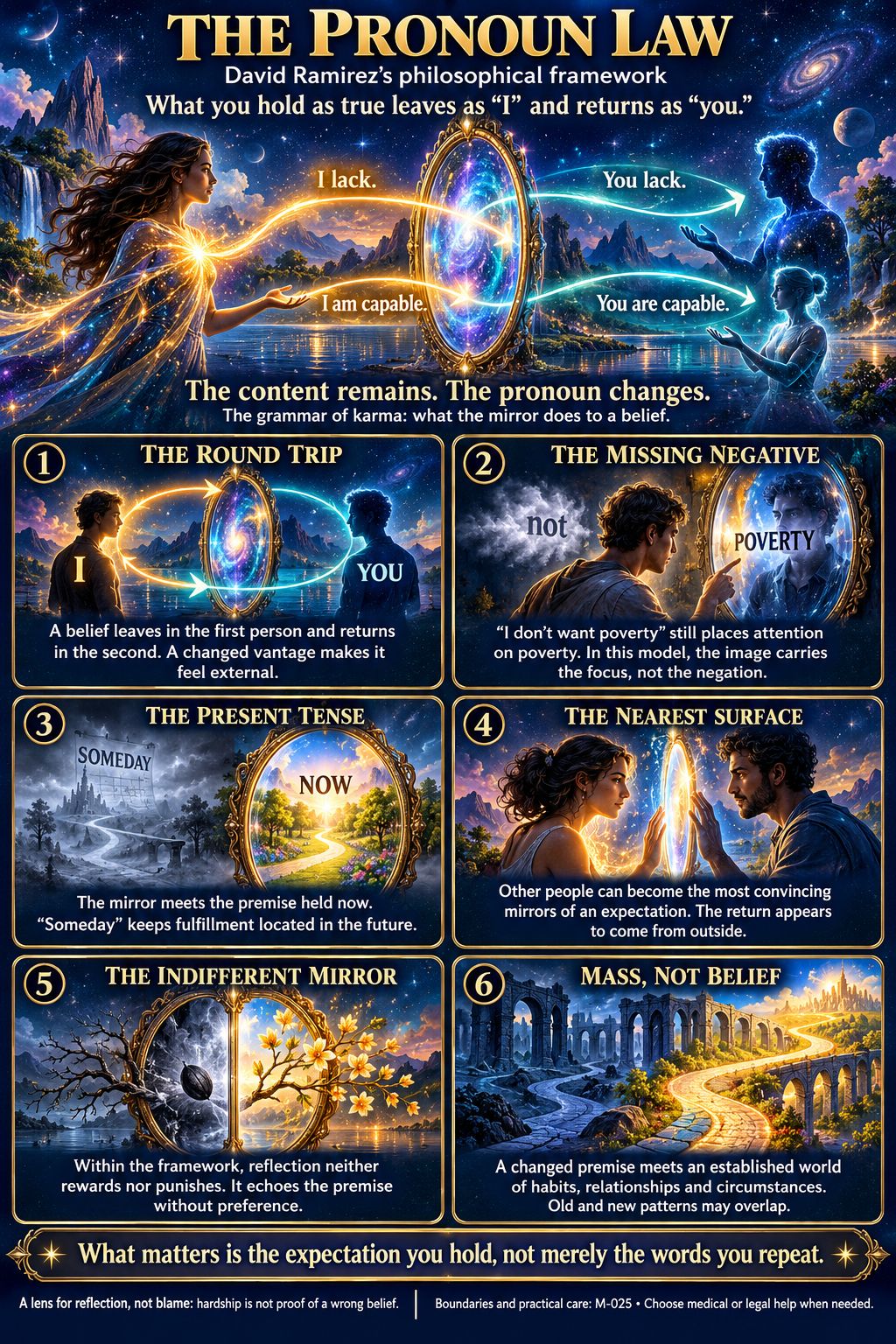
The whole law in one plate. Every part of it is set out in words below, so nothing here depends on being able to see the picture. Made with the aid of AI image tools, then curated and captioned by David Ramirez. How this was made
What you hold as true leaves you in the first person and returns to you in the second. Nothing is added and nothing is refused. The pronoun changes, because that is the only change a sentence undergoes on a round trip.
The law
"I lack" returns as "You lack." It does this for every belief that comes out of your thought processes, without preference and without exception.
What this is, and what it is not
This is not a new law standing beside karma. It is the grammar of the one the Practical Lessons already define.
S-006 establishes the scale, and then says the thing that matters here: anyone who consistently provokes a strong reaction in you is holding up a mirror. That lesson names the mirror. It does not say what a mirror does to a sentence. This page is that, which makes the Pronoun Law the grammar of karma rather than an addition to it.
Which also settles its rank. It is a law, referenced from many lessons, not a lesson among them. It is written to be read once and then recognized repeatedly.
Part One of six
The Round Trip
First person is the only person you can speak from. Second person is the only person you can be spoken to in. So a belief can leave only as "I" and arrive only as "you." Nothing decided this. There is no editor changing the pronoun out of judgment or instruction. It is the sole way a sentence can make a round trip and still be the same sentence.
This matters because it removes the agent. People hear that the universe reflects a belief and picture a listener weighing whether to grant a request. There is no listener and no request. The content never changed. What changed is the seat it is read from.
Which is why the return arrives feeling as though it came from somewhere else, and why people name it fate, luck, timing, or God's will. That feeling is not an error to be corrected. It is accurate about the vantage and wrong only about the cause.
Where this lands in the courses
M-001 The Life You Are Standing In. M-001 opens by observing that most people meet their life as though it arrived from somewhere else, and disputes the claim without explaining the feeling. This is the explanation.
Part Two of six
The Missing Negative
Stand in front of a mirror, point at your reflection, and say "not this." The glass shows you a person pointing at himself.
Negation is an operation of language, not of image. A mirror has no "not" available to it. So "I do not want to be poor" returns as attention resting on poverty, and the sentence performs the opposite of its stated job.
Belief works on nouns and on where the attention sits. Your operators do not cross over. This is the most immediately usable part of the Law, and the test is mechanical: read your own stated intention and count the negations. Every one of them is naming the thing you are trying to leave.
Part Three of six
The Present Tense
A mirror has no memory and no forecast.
"I will be wealthy" describes a person who is not standing in front of the glass, so there is nothing there to return. Future tense is the subjunctive wearing a calendar. It feels like an improvement on "I want" because it sounds settled, and it is the same sentence with a date attached.
This is why "someday" is the most reliable way never to arrive. It is a sentence the mirror cannot answer, so nothing comes back, and the silence is experienced as continued lack, which then gets read as evidence.
Where this lands in the courses
M-003 What You Send Out Is an Expectation. M-003 establishes that expectation is the thing that actually leaves a person. The deferred expectation is its own failure mode, and this is where it is named.
Part Four of six
The Nearest Surface
People are the most convincing surface the mirror has.
"I am not taken seriously" leaves in the first person and arrives through a colleague's mouth in the second. "I am too much" arrives as someone stepping back. The return needs a surface, and a person is the only surface that can deliver a sentence in words, at the right moment, with feeling behind it.
This is why the return so often feels like other people's fault, and why the fault is so easy to document. The evidence is real. The colleague did say it. What the Law adds is that the sentence was in circulation before he spoke it.
Two things this does not license. It does not excuse what anyone did, and it does not mean a person who harmed you was delivering a message. The claim is narrower: that your reaction belongs to you, and that the pattern which repeats across different people is worth reading as your sentence rather than their coincidence.
Where this lands in the courses
S-006 Karma, Correctly Defined. S-006 already claims that people hold up the mirror. This supplies the reason it is people rather than circumstances.
Part Five of six
The Indifferent Mirror
It does not prefer abundance to lack, and it is not on your side.
The return is not benevolent. It is accurate. A person who holds deeply that he is unworthy receives a precisely accurate world, delivered with the same fidelity as anyone else's. Nothing in the mechanism is trying to help.
Most teaching in this field softens this, because indifference is harder to sell than favor. But the encouraging news and the hard news here are the same news, and a teaching that delivers only the first half has to explain away every case where the second half showed up. This one does not have to.
Part Six of six
Mass, Not Belief
A premise held for thirty years has built a world around it. Habits, relationships, a resume, a room, the particular set of people who find you legible.
Change the premise and that world does not stop answering, because most of it is no longer belief. It has become mass. The calendar still holds the old appointments and the old people still expect the old person, and all of that is still faithfully returning a sentence you have stopped saying.
So for a period two returns arrive at once, and they contradict each other. This is what gets called a plateau, or a dark night, and it is where reversion happens: the old world is more convincing for a while simply because there is more of it.
Naming this in advance may be the most practical thing on this page. A reader who expects one clean switch reads the overlap as failure. A reader who expects two returns reads it as the ordinary shape of the change.
Where this lands in the courses
M-021 When Nothing Has Changed. M-021 names four explanations for a method that has not worked yet. This is a refinement of its first and third, and it accounts for reversion, which that lesson does not.
What the courses already say
Six things that belong to this subject are already established elsewhere and are better stated there. They are listed rather than repeated.
M-003. Why affirmation fails. The sentence read aloud each morning is noise laid over an unchanged expectation, and the expectation is what leaves.
M-004. Belief, expectation and assumption kept apart, which is the distinction that explains three different observed failures.
M-014. The analytical mind, and the observation that a person giving a complete causal account has placed himself inside it as an effect.
S-006. Karma as the scale, and the seeking rather than the object as the thing that tips it.
S-015. The satisfaction loop, where closing the distance on one object does not end the sentence but points it at the next thing.
M-025. Where the whole method stops, including the instruction to choose a lawyer, a doctor or a person who will sit with you over an exercise.
Where this stops
The limit, stated here rather than in a footnote
This page describes how an inner premise keeps getting confirmed. It is not a theory of who deserves what. The mirror does not move mass: it changes what you notice, what you attempt, what you tolerate and who you become legible to, and those change a life, but it does not pay a debt by itself or cure an illness. If you are holding something heavy, the test in M-025 comes before anything on this page, and the answer it gives may be that the next step is not a practice at all.
Lineage
Watts walks to the paradox and stops short of the mirror. His law is a logic of desire rather than a claim about a responsive cosmos, and it is worth reading him for the stopping as much as for the walking.
The responsive part is the Kybalion's, where mentalism and "as above, so below" is already a statement about reflection, and Seth's, where circumstance is the outward form of belief.
Neville Goddard is the closest match to the argument about tense. Assume the feeling of the wish fulfilled is exactly the move out of the subjunctive, made a century before this page. He is cited in M-004 for assumption, and part three above extends that citation rather than adding a source.