
"The highest consciousness is not control. It is ambivalence."
DAVID RAMIREZ
I. The Human Need for an Explanation
Human beings have always attempted to explain why we exist. We look at the beauty, suffering, order, and unpredictability of life and assume there must be a hidden reason beneath it all. We create stories of gods, creators, divine plans, cosmic laws, reincarnation, karma, salvation, awakening, and return. Although these explanations differ, they generally begin with the same assumption: existence must be leading somewhere.
Traditional religions tell us we have fallen away from God and must find our way back. Gnosticism suggests something divine within us has become trapped in an imperfect material order and must awaken through special knowledge. Hindu traditions describe the human condition as ignorance of our true nature and liberation as the realization of our relationship with ultimate reality. Modern metaphysical systems such as the Seth Material and Ramtha replace the older vocabulary of sin and salvation with consciousness, manifestation, frequency, ascension, and creative mastery.
Each system provides a different map. The maps frequently share the same structure: we have forgotten what we are, our ordinary condition is incomplete, and some realization, discipline, or hidden knowledge will restore us.
This creates the seeker.
The seeker begins with the belief that what we presently are is not enough. Something is missing. Something must be discovered, healed, transcended, or remembered. The destination may be called heaven, enlightenment, liberation, ascension, self-realization, or unity with the Source, but each promise directs our attention away from the experience occurring now and toward an imagined condition in the future.
The search may begin honestly. We sense that the identities and beliefs we have inherited do not fully explain us. We recognize the limitations of conventional religion, materialism, and social conditioning. We begin questioning what we have been told. But the ego is extraordinarily adaptive. When its ordinary ambitions become transparent, it does not necessarily disappear. It adopts a more sophisticated purpose.
The desire to become important becomes the desire to become awakened. The desire to acquire possessions becomes the desire to acquire spiritual knowledge. The desire to control other people becomes the desire to control reality. The desire to preserve the personality becomes the belief that the personality is an eternal soul.
The ego does not end. It learns the language of transcendence.
II. The New Metaphysical Promise
The Seth Material and the teachings of Ramtha offer compelling alternatives to traditional creation stories. Both suggest that consciousness is not produced by matter, but that matter is an expression of consciousness. Seth describes the ultimate source as All That Is, an infinite field containing every possible world, identity, and form of consciousness. Ramtha begins with the Void, an unlimited condition of no form, no time, no movement, from which Point Zero emerges as the first localized observer within unlimited potential.
Both systems describe creation as consciousness encountering itself through differentiation. The One becomes the many so that possibility may become experience. Human beings are consequently presented not as powerless products of creation but as expressions of the creative Source. These teachings can initially feel liberating. We are no longer condemned sinners or accidental organisms living in an indifferent universe.
But these systems also present a subtle temptation. The individual begins to believe that spiritual knowledge provides access to the hidden machinery of reality. If consciousness creates experience, then perhaps we can learn to manipulate consciousness, raise our frequency, select a preferred timeline, or manifest the reality we desire.
The ancient promise of salvation becomes a modern promise of mastery.
III. The Cheat-Code Contradiction
If the purpose of physical existence is for the Source to experience limitation, why would the Source reveal methods for escaping or controlling that limitation? If forgetting our divine identity makes an authentic human experience possible, why provide teachers who reveal that we are the Creator? If the game depends upon our complete identification with the character, why distribute the game's cheat codes to some of the characters?
The contradiction is difficult to avoid. If ignorance is necessary for the experience, awakening interferes with the experience. If awakening is the intended objective, then ordinary life becomes merely a preliminary stage that must be overcome. Once again, the present is reduced to preparation for something supposedly higher.
Traditional religion tells us to live correctly now so we may enter heaven later. Modern metaphysics tells us to expand our consciousness now so we may ascend, awaken, or master reality later. The language changes, but the psychological movement remains the same.
We are still trying to get somewhere.
Perhaps teachings such as Seth and Ramtha are not cheat codes at all. Perhaps they are simply additional features within the game: explanations that appear when a particular kind of mind can no longer accept conventional explanations. They provide spiritual shelter for those who have rejected traditional religion but still desire a purposeful universe. The trap does not necessarily lie in the teaching itself. The trap begins when we convert the teaching into certainty and use it to protect ourselves from mystery.
IV. Projecting Desire Onto the Source
The belief that the Source created individual beings in order to experience itself contains a deeper contradiction. A desire arises from the perception that something is absent. A goal requires a future condition believed to be preferable to the present one. Experience, when treated as a necessity, suggests that the experiencer is incomplete without it.
If the Source is infinite, complete, and all-knowing, what could it possibly lack? If it must divide itself into individual beings in order to understand itself, then it was not complete before creation. If it deliberately forgets what it is so that it can eventually remember itself, creation begins to resemble an elaborate cosmic game in which suffering is made necessary for the satisfaction of the Creator.
We may be attributing human psychology to something beyond human comprehension. We experience curiosity, loneliness, ambition, and the need for growth, so we imagine a Source that creates for the same reasons. We turn God into an enlarged version of the seeker. The Source becomes another ego trying to fulfill itself.
Perhaps creation does not occur for a reason. First Cause could not be responding to a previous condition, because nothing would precede it. It could not seek a future result, because time itself would be part of what emerged. Creation may therefore be spontaneous rather than purposeful. It may be the natural expression of possibility without an intended destination.
The honest answer may not be another cosmology. It may be that we do not know.
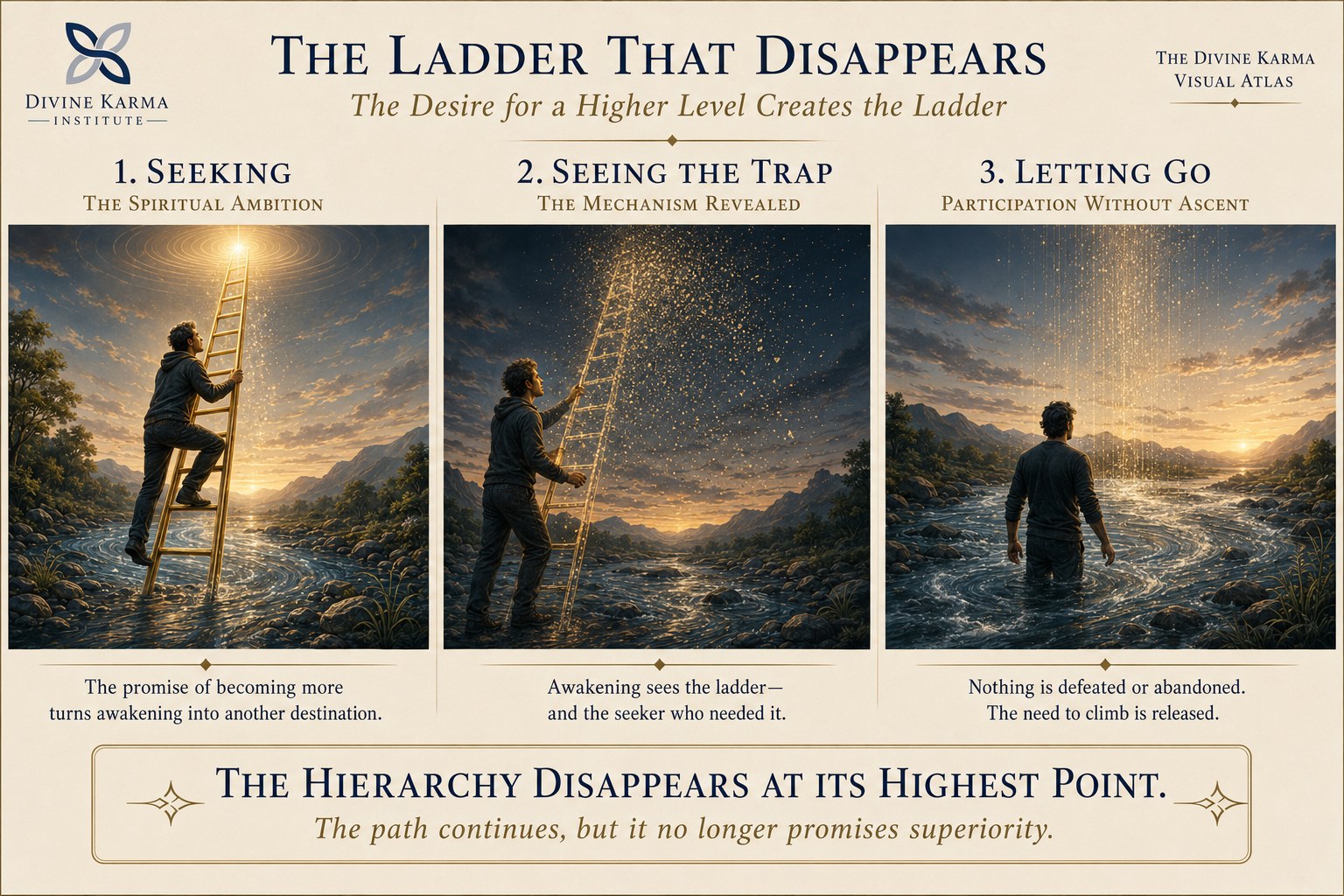
V. Awakening as the Ego's Final Ambition
The ego is the functional identity through which we navigate physical existence. It is not inherently evil and cannot simply be destroyed. The problem begins when this temporary instrument imagines itself to be the whole of what we are and becomes attached to preserving its identity, beliefs, and desired outcomes.
The spiritual seeker often recognizes the limitations of the ego but then makes the destruction of the ego its new objective. This creates another conflict within the self. The ego divides itself into the part that must be transcended and the spiritual observer attempting to transcend it. The self now attempts to defeat itself in order to become a superior self.
This is why the spiritual ego can be more difficult to recognize than the ordinary ego. Its ambition appears noble. It claims to seek truth, freedom, and unity. It may renounce material success while becoming deeply attached to spiritual status. It may speak of oneness while privately measuring its consciousness against the consciousness of others. It begins classifying people as awakened or asleep, high-frequency or low-frequency. It has not disappeared. It has placed itself above the other characters in the game.
Even the statement I am the Creator can become the ego's ultimate declaration of importance. What begins as an insight into interconnectedness may become a metaphysical enlargement of the individual personality.
The mechanism underneath this is grammatical, and it is what makes the trap self-sustaining rather than merely ironic. What a person holds as true leaves them in the first person and returns in the second. "I am not yet awakened," held sincerely and held daily, is a sentence about someone who has not arrived, and what returns is a world in which they have not arrived. The seeking does not fail because the seeker was insufficiently sincere. It succeeds, precisely, at what was sent.
Two properties of that return are what make the ladder look real. It has no future tense, so an intention set ahead of the present has nobody standing in front of it and nothing comes back, which is experienced as the destination receding. And it does not carry negation, so "I must stop being the ego" returns as attention resting on the ego. This is the same movement The Way names as the final trap, described from the side of the sentence rather than from the side of the self. It is set out in full at The Pronoun Law.
There is a second name for this in this work, and it is the plainer one. If an addiction is any condition in which we keep ourselves habitually occupied with something in order to avoid facing an obstacle, or a wound, that we have not yet been willing to meet, then spiritual seeking qualifies whenever it is doing that work. It qualifies more easily than most, because nothing about it looks like avoidance from the outside, least of all to the person doing it.
VI. U.G. Krishnamurti and Suzuki
U.G. Krishnamurti challenged the entire assumption that enlightenment is a condition the individual can or should attain. He argued that our image of enlightenment is supplied by culture, gurus, scriptures, and spiritual traditions. We compare our ordinary condition with this manufactured ideal and conclude that something is wrong with us. The spiritual marketplace survives by first convincing us we are incomplete and then offering methods for becoming complete.
His position can sound nihilistic because it removes the consolation of a destination. But the absence of a cosmic destination does not mean life becomes worthless. The body continues living. It eats, sleeps, protects itself, forms relationships, responds to circumstances, and eventually dies. Life does not require a metaphysical explanation before it can be lived. U.G.'s rejection of awakening should not become another doctrine, however. The anti-seeker can become just as attached to non-seeking as the seeker was attached to awakening.
D.T. Suzuki described purposelessness as moving beyond teleological consciousness, and Shunryu Suzuki as acting without a gaining idea. When we meditate in order to become enlightened, enlightenment becomes another object of desire. Purposelessness does not mean we become inactive. It means our actions are no longer psychologically dependent upon the reward we expect them to produce.
A dance does not fail because it ends where it began. Music does not become meaningful only when it reaches its final note. A flower does not bloom in order to receive recognition for blooming.
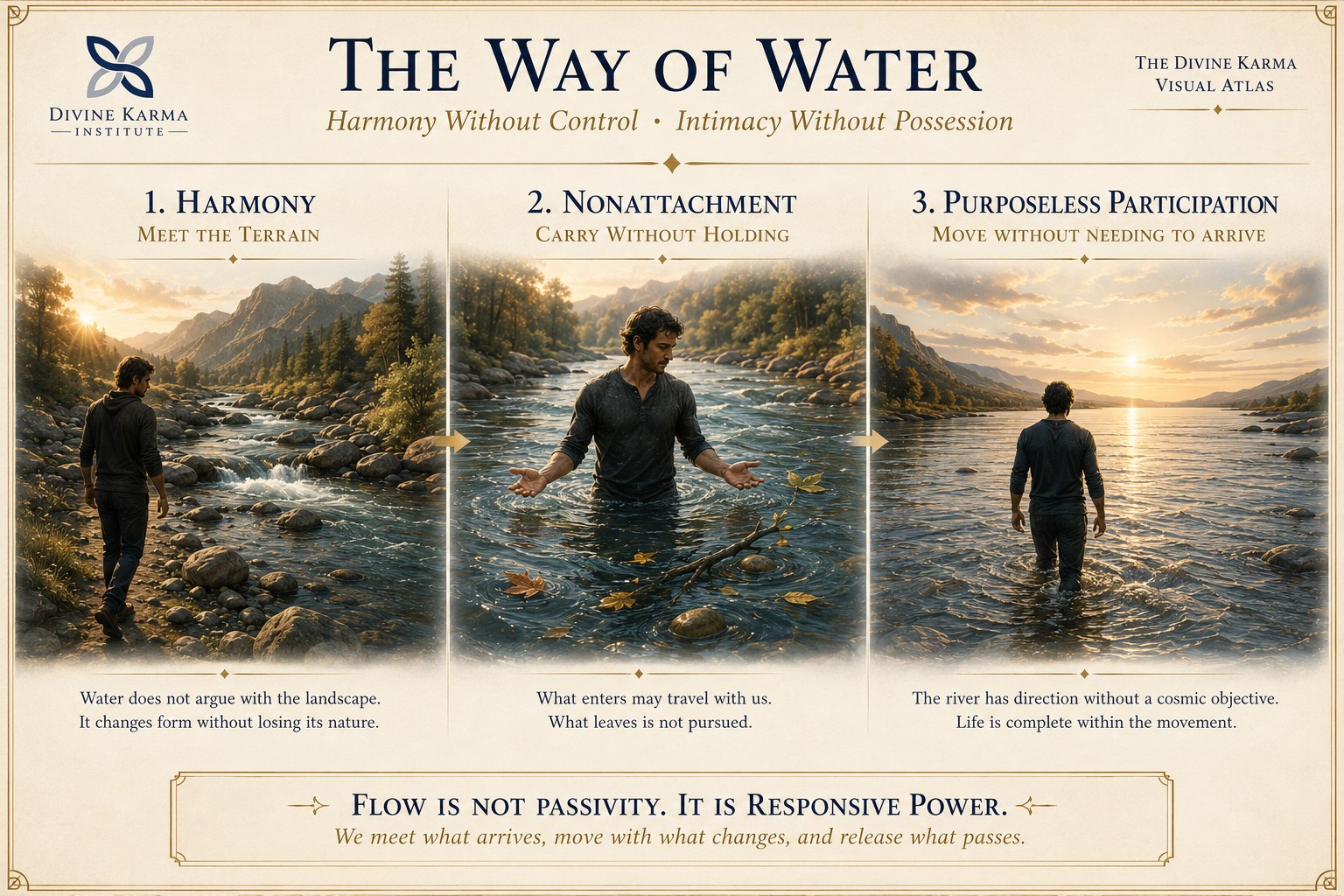
VII. The Way of Water
Water does not attempt to control its movement. It responds to the terrain before it, following the path of least resistance without demanding that the landscape conform to its preferred direction. When it encounters an obstacle, it does not interpret the obstruction as a personal injustice. Its surrender is not weakness. Water can nourish a forest, carve through stone, carry enormous weight, and reshape the land. Its power comes not from imposing one permanent form upon the world, but from remaining responsive to the conditions it encounters.
This is the meaning of harmony.
Everything that enters the water may travel with it for a time. A leaf, branch, or stone may become part of its movement, but the water does not attempt to possess what it carries. When the current changes and the object moves elsewhere, the water does not reach backward to recover it.
This is the meaning of nonattachment.
Water holds nothing, yet it rejects nothing. It receives what enters, carries what remains, and releases what departs. It simply does not build its identity around preserving any temporary passenger.
This is ambivalence.
Water does not need to know where the river ultimately ends before it begins to flow. It does not search for a higher river, attempt to escape the valley, or treat each bend as preparation for some final destination. Its nature is expressed through the movement itself.
This is purposeless participation.
Water does not awaken by reaching the ocean. It was always water. The river, rain, mist, ice, and ocean are different expressions of the same essence. No expression is spiritually superior to another. Awakening is recognizing that we are water while believing ourselves to be only the temporary shape through which it moves. Ambivalence is no longer needing to escape the shape.
VIII. Ambivalence as the Highest Form of Consciousness
Ambivalence does not mean apathy, indecision, emotional numbness, or a lack of concern. It is the ability to remain inwardly free while fully experiencing both sides of life. It is awareness without attachment to a predetermined outcome.
We may prefer one outcome over another. We may work passionately to achieve it. We may protect what we love and resist what threatens it. But our inner completeness no longer depends upon forcing reality to obey our preference. Ambivalence allows us to act without becoming psychologically imprisoned by the result. It holds the opposites without needing to destroy either side.
Pleasure is welcomed but not captured. Pain is encountered but not converted into identity. Success is appreciated but not used as proof of personal worth. Failure is felt but not accepted as a final definition of the self. Love is expressed without turning the beloved into a possession. Loss is mourned without denying impermanence.
It is intimacy without possession. Emotion without imprisonment. Complete participation without the need to win. This is why ambivalence is the highest consciousness while also being the end of spiritual hierarchy. It is not higher because it makes us superior to anyone. It is highest because it releases the need to be measured against anyone.
Ambivalence cannot become a spiritual trophy. The moment we attempt to possess it, we are attached again. It appears whenever we release our demand that the present experience satisfy our expectations. It is not a place at the end of the journey. It is the manner in which we walk.
IX. The Four Stages of Consciousness
The movement toward ambivalence can be understood through four stages. These describe a change in relationship with experience, not a ranking of human worth.
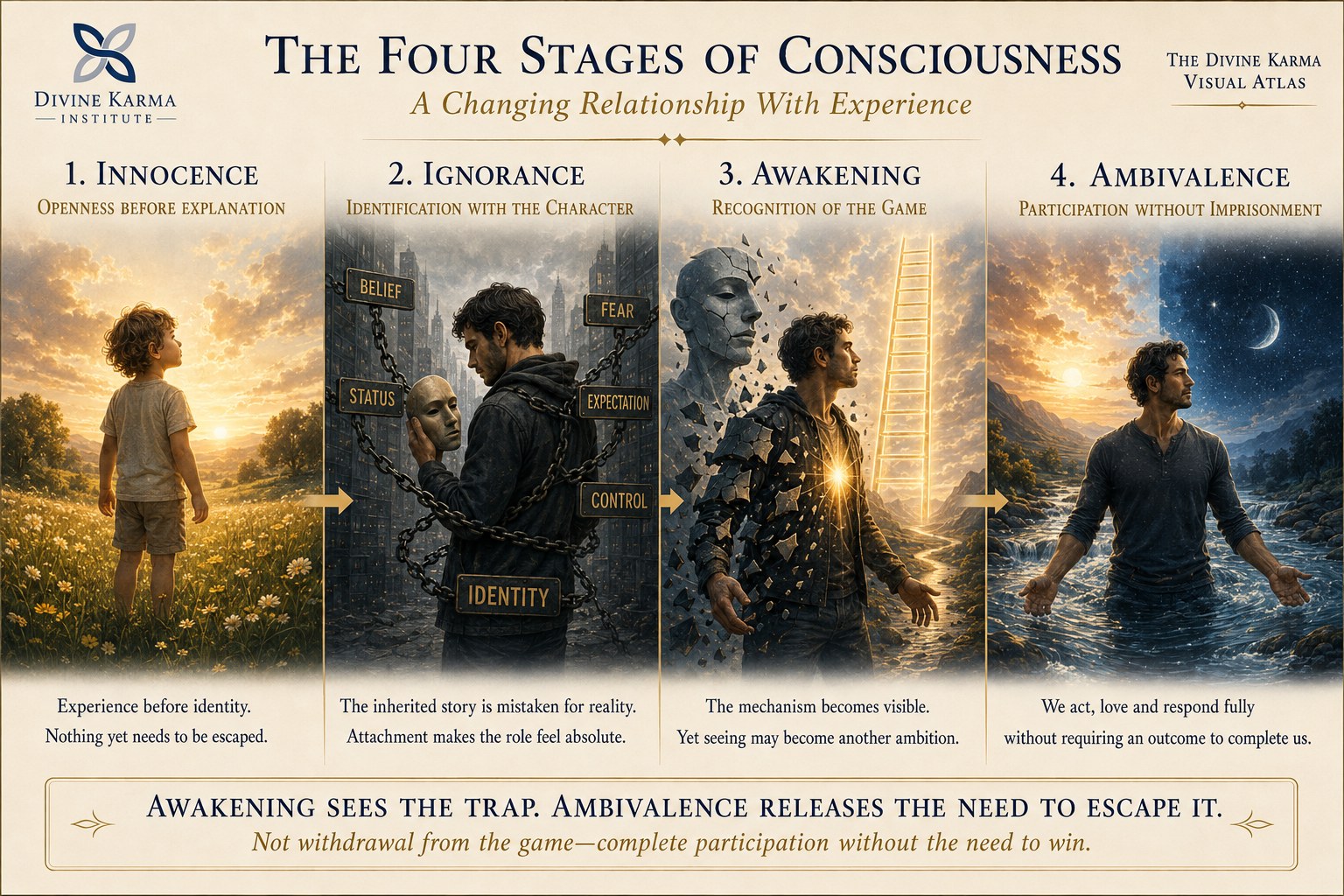
Ambivalence is not the destruction of the character. It is the balancing of the Ego Self and the True Self. The ego allows us to function within the dense material experience. Awareness prevents us from becoming completely imprisoned by its demands. In ambivalence, we can care deeply without demanding permanence. We can act decisively without believing we control every consequence. We can participate fully without requiring life to take us somewhere else.
X. The Final Revolution
The Revolution of the Mind is not the replacement of one belief system with another. It is not moving from religion to metaphysics, from God to consciousness, or from salvation to awakening. The final revolution occurs when the mind recognizes its compulsion to turn every insight into another destination.
We no longer need to know with certainty why the universe exists. We do not need to decide whether the Source created us for experience, whether we selected this life, whether reality is a simulation, or whether consciousness is dreaming the physical world. These ideas may remain useful possibilities. But we hold them lightly. We do not allow them to separate us from the experience they attempt to explain.
We stop searching for the hidden mechanism that will permit us to control life. We stop measuring our consciousness against the consciousness of others. We stop treating pain as evidence that we have failed spiritually. We stop converting every experience into a lesson that must advance us toward a higher state. We allow life to be lived before it is explained.
The highest realization is not that we are the Creator. It is that we do not need to know whether we are the Creator in order to participate completely in creation. The highest practice is not mastery. It is harmony. The highest consciousness is not control. It is ambivalence.
The only purpose we need is to meet the experience presently unfolding, respond to it as clearly as we can, and release it when it passes. There may be nothing to escape. There may be nothing to complete. There may be nowhere else to arrive.
Closing
Conditioning · Seeking · Seeing the Trap
Letting Go · Participating Fully
We stop looking for the way out and become intimate with the way life is.
So we let go.
And then we flow.
A canonical addendum for The Central Thesis, The Revolution of the Mind, the Canonical Companion, and The Way. Reflection, not doctrine. Cannon, Ramtha, and Seth references are used philosophically and symbolically, not presented as findings established by conventional empirical science. The Institute's writing and apps are for reflection and are never a substitute for mental health care.